Everything You Need to Manage Digital Trust—in One Platform
Centralize PKI, certificate lifecycle management, DNS, and trust services without tool sprawl.
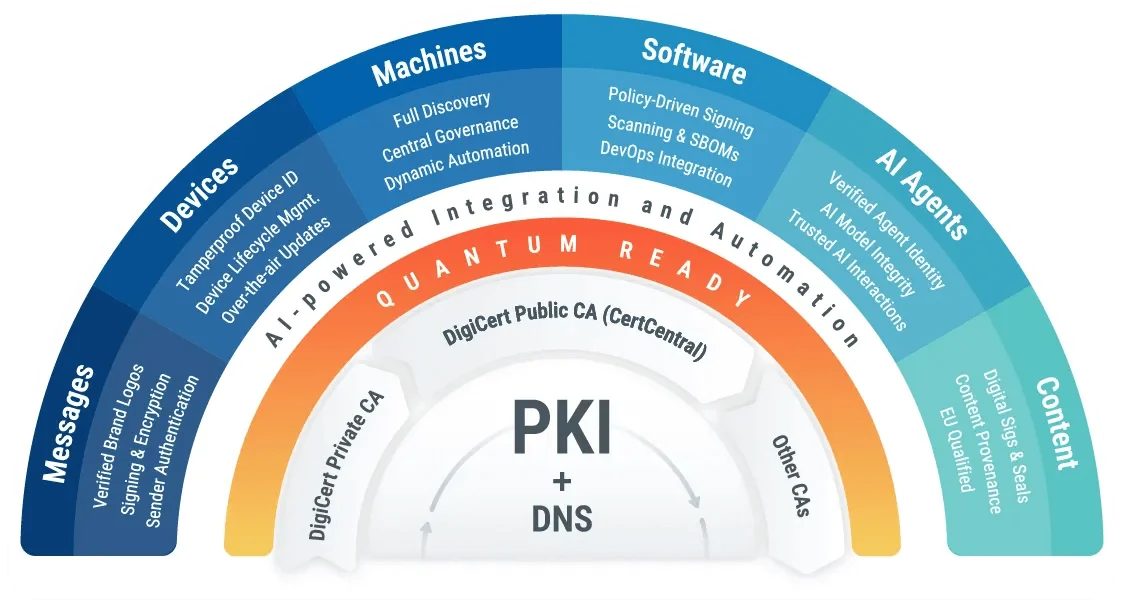

Certificate Lifecycle
Get full visibility across your PKI landscape and avoid outages.

Software Trust
Release secure software while lowering remediation and compliance costs.
Device Trust
Protect IoT devices with complete lifecycle security, from manufacturing to decommissioning.
Document Trust
Safeguard digital documents and transactions with trusted integrations and global compliance.
DNS >>
DigiCert Public CA (CertCentral) >>
Private CA

Why Digital Trust Fails at Enterprise Scale
- Expired certificates cause outages
- Manual PKI processes don’t scale
- Compliance gaps increase security risk
- Tool sprawl slows security teams
Trusted by the World’s Most Security-Sensitive Organizations
When downtime, compliance, and trust matter, enterprises choose DigiCert.

Of Fortune 500
Partner with the best. Get the world’s most advanced digital trust platform to power and secure all your connections.

Uptime since 1999
Everything digital stops without DNS. Choose the most resilient service that serves 20% of the world’s DNS queries.

Machine identities
PKI is everywhere. Manage all of it with one platform: machines, software, documents, IoT devices, humans, AI agents, servers, and more.
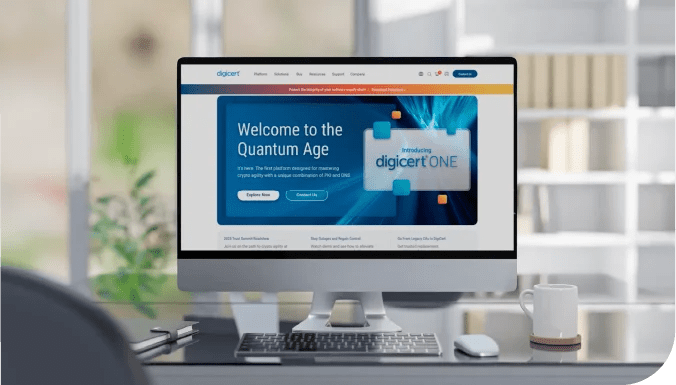
Quantum-Ready Security—Without Replacing Your Stack
Prepare for post-quantum cryptography while maintaining compatibility with today’s systems.
Built for Real Enterprise Use Cases
- Secure hybrid cloud environments
- Automate DevOps certificate workflows
- Protect IoT and device identities
- Maintain compliance across regions

What You Achieve With DigiCert

Prevent outages caused by expired certificates
Stop outages with proactive alerts on certificate expirations and automated renewals. Build for the future with quantum-ready cryptography. Scale effortlessly with a flexible cloud service.

Reduce operational risk with automation
Ensure security and compliance across your certificate landscape with centralized policies and governance. Skip the exponential costs of fixing software security flaws after it’s been released.

Accelerate compliance across global teams
Replace manual PKI and DNS management with policy-driven automation, seamless integrations, and self-service tools, ensuring agility, efficiency, and optimized resource allocation across your organization.

Scale securely without adding headcount
Build customer loyalty with a strong track record. Reduce your attack surface with code scanning for malware, vulnerabilities, and exposed secrets while automating risky manual processes.
The Total Economic Impact of DigiCert ONE
Forrester estimates a composite organization achieved 312% ROI and a Net Present Value of $10.1M with DigiCert ONE.

What our Customers Say
By integrating with DigiCert ONE,
DigiCert became the backbone of our enterprise trust strategy.
“At the end of the day, it’s about trust, and DigiCert supports our ability to ensure trust when we process our customers’ sensitive traffic.”
-Lidor Pergament, Director of Product Management, Zscaler
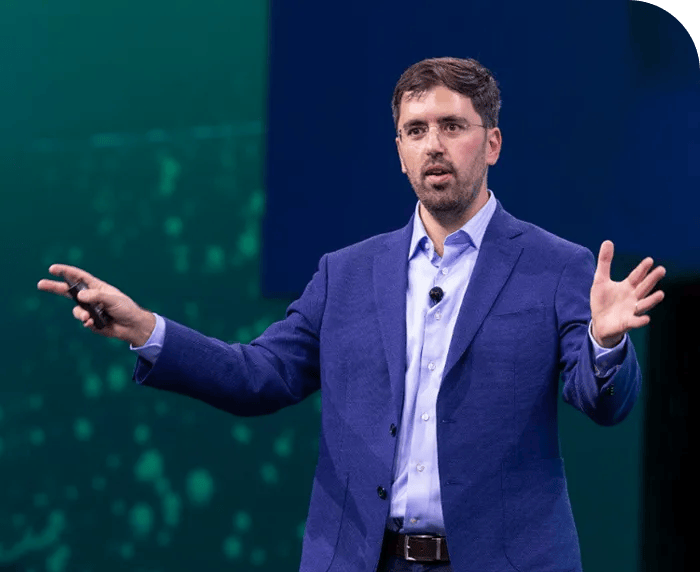

"Digital trust is the cornerstone to the foundation of an organization and without it organizations are vulnerable to every threat."
SEAN SWEENEY, CHIEF INFORMATION SECURITY OFFICER



Digicert FAQ
Authentication: For every new session a user begins on your website, their browser and your server exchange and validate each other’s TLS/SSL certificates.
Encryption: Your server shares its public key with the browser, which the browser then uses to create and encrypt a pre-master key. This is called the key exchange.
Decryption: The server decrypts the pre-master key with its private key, establishing a secure, encrypted connection used for the duration of the session.
Browsers: Just as websites are designed to be device and browser agnostic, TLS/SSL is supported by all major web browsers.
Servers: A TLS/SSL certificate can be supported by any server. It’s up to the browser to determine the security of a server during the handshake process.
Email: Most cloud-based email providers use TLS/SSL encryption. Organizations can also install an TLS/SSL certificate to protect private email servers.
Get a personalized walkthrough. No sales pressure. Enterprise-only consultation.

The most-trusted global provider of high-assurance TLS/SSL, PKI, IoT and signing solutions.
© 2026 DigiCert, Inc. All rights reserved.